How to operate a boat without a licence
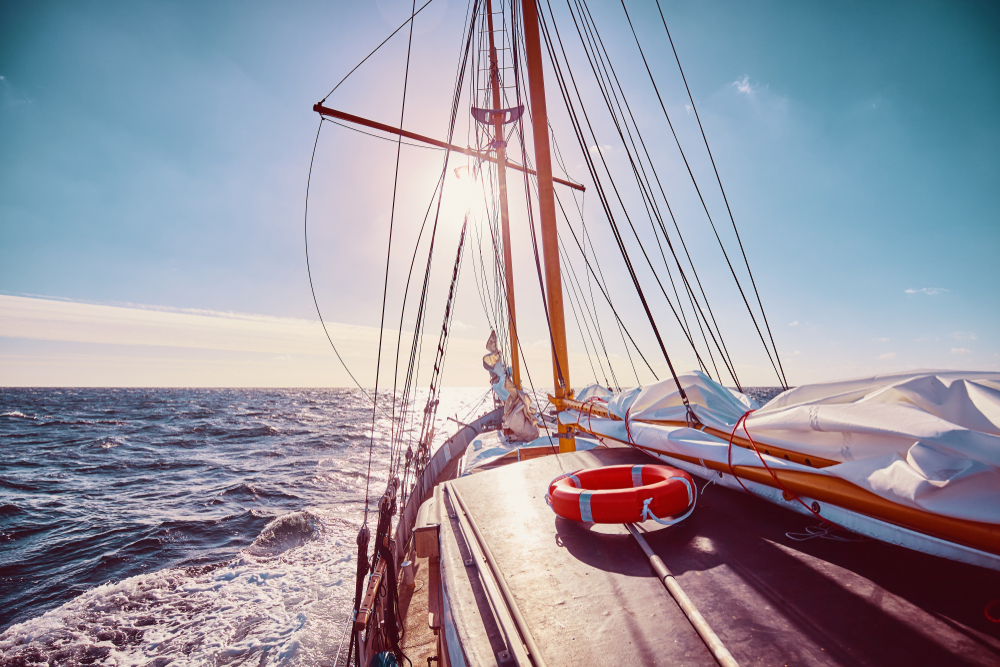
Sailing is a dream for many. Standing aboard a small boat, it is easy to find yourself admiring the yachts moored in the marina — impressive with their aerodynamic lines or striking with their twin hulls.
You may also be fascinated by a beautiful sailing yacht leaving the harbour under sail. But what if the skipper did not hold a boating licence?
Operating a boat without a licence: making your sailing dream a reality
Not having a boating licence is not necessarily an obstacle to getting out on the water, although caution and safety must always remain the priority.
It is therefore possible to consider operating a boat without a licence. However, this does not mean renting a motorboat or sailing yacht and immediately setting off without having taken the necessary precautions. One of the most important steps is, of course, to complete both theoretical and practical training beforehand.
What does the law say about operating a boat without a licence?
In France, the legal framework governing licence-free navigation is relatively clear and straightforward, although in practice it often relies on individual judgement.
A boating licence is required to operate any motor-powered pleasure craft with an engine output exceeding 4.5 kW (6 hp), whether at sea or on inland waterways.
For reference, “inland waters” at sea are defined as waters located landward of the baseline — the geographical limit separating the submerged territory of a coastal state, such as France, from the maritime domain. Beyond this line lie territorial waters.
Inland waters also include all freshwater navigation routes, such as rivers, lakes, ponds and canals.
It is also important to note that a vessel may be equipped with both sails and an engine producing more than 4.5 kW. In such cases, the vessel is legally defined as a sailing boat if it is primarily propelled by wind power, with the engine serving only as auxiliary propulsion, typically for harbour manoeuvres.
Learning to sail: an essential step
Operating a sailing yacht cannot be improvised, and it would be highly irresponsible to do so without at least basic training.
Before choosing your sailing yacht — whether for purchase or charter — it is therefore advisable to enrol in a sailing school to acquire the necessary skills and knowledge.
Operating a boat without a licence safely
Before considering the purchase or charter of a sailing boat and planning to navigate without a licence, it would be irresponsible not to undertake at least basic training.
To approach navigation responsibly, you must be aware of your actual level of experience. You may never have stepped aboard a sailing boat, or you may already be familiar with basic sailing terminology and equipment, yet still lack sufficient hands-on experience.
Theoretical knowledge alone is never sufficient to navigate safely; it must always be complemented by practical experience at sea.
For sailing training in France, it is recommended to seek information from the French Sailing Federation (Fédération Française de Voile).
Some specific cases when operating a boat without a licence
Depending on the navigation area, and provided that the engine power of your vessel does not exceed 4.5 kW, there are certain particular situations in which additional documents may be required or specific measures must be taken.
Sailing with the mast lowered on inland waterways
Many inland waterways belonging to the Public River Domain (DPF) are managed by Voies Navigables de France (VNF) under French law.
For waterways of commercial navigation interest, local authorities issue a Special Navigation Regulation (RPP – Règlement Particulier de Police), which defines navigation rules for each route.
Boat operators are expected to consult these regulations. Once informed of the applicable conditions, they may navigate without a licence aboard a sailing boat provided the mast is lowered.
Obtaining a navigation certificate
On certain inland waterways considered to present low hydraulic risk, a boating licence is not required provided the navigator holds a certificate authorising navigation.
This certificate is issued by the charter company and allows navigation:
- on non-habitable boats under 5 metres, or
- on habitable boats between 5 and 15 metres in length
The same rule applies on closed inland water bodies, defined as areas where the vessel cannot leave the water surface while remaining afloat.
Carrying a VHF radio beyond 6 nautical miles
Following revisions to Division 240 of French maritime regulations, navigation beyond 6 nautical miles from a place of shelter requires a VHF radio on board.
To use this equipment, the navigator must hold a Restricted Radiotelephony Operator’s Certificate (CRR), particularly for navigation in international waters.
It is also worth noting that some European countries, such as Croatia, require a boating licence when operating a vessel if you are not the owner.
Navigating without a licence in France
In France, you may navigate without a boating licence if your vessel meets one of the following conditions:
- it is not equipped with an engine exceeding 4.5 kW (6 hp), or
- it is equipped with such an engine but sail power remains the vessel’s primary means of propulsion
Under these conditions, licence-free navigation remains possible, provided the skipper exercises sound judgement and complies with all safety regulations.