
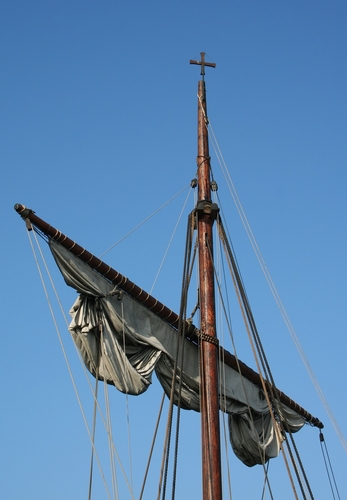
“Shroud tuning: the process of adjusting or consolidating mast settings using the shrouds.”
While the definition appears straightforward, its practical application is considerably more complex.
A brief overview of mast tuning
A yacht’s behaviour under sail, manoeuvring efficiency and onboard safety are all fundamentally dependent on correct rig tuning. The mast lies at the very core of this balance.
Focusing on shrouds, several key questions arise: where are they positioned relative to the mast, what is their role, and how do they function?
However, it is essential to note that mast tuning involves three primary parameters:
- lateral alignment,
- mast rake,
- mast bend.
Shrouds alone are not sufficient to achieve proper tuning. Correct tensioning of the forestay, backstay, and—on fractional rigs—running backstays, is equally critical. All these elements form part of the standing rigging.
Excessive shroud tension, incorrect mast bend, or poor vertical alignment will compromise sail efficiency and vessel performance. More critically, safety may be jeopardised, potentially leading to dismasting or structural failure of the mast.
Shrouds: location, function and operation
On a sailing yacht, shrouds are positioned on either side of the mast. Their function is to maintain the mast in a vertical plane relative to the deck, with tension adjusted באמצעות turnbuckles.
Each shroud is secured:
- at the mast, and
- at deck level via a chainplate fitted with an adjustable turnbuckle.
Shrouds absorb transverse loads generated by the sails and prevent the mast from buckling under stress.
- Cap shrouds maintain the mast laterally. They are attached at the masthead on masthead rigs, or at the forestay attachment point on fractional rigs. They pass over the spreader tips and are led to the deck.
- Intermediate shrouds are found on rigs with multiple spreader levels. They are attached at the height of the upper spreaders and ensure lateral stability in that հատված.
- On discontinuous rigging, they terminate at the lower spreader tips.
- On continuous rigging, they run continuously down to the deck.
- Lower shrouds stabilise the mast longitudinally and influence mast rake. They are attached near the first spreader level and help prevent excessive mast bend.
Mast tuning and verification under sail
Prior to stepping the mast, always refer to the rigging plan provided by the shipyard.
Initial adjustments should be carried out in harbour, then refined at sea under steady wind conditions. As a reference, in approximately 8 knots of wind, the mast should appear perfectly straight laterally.
Lateral alignment
The objective is to centre the mast relative to the yacht. This is achieved by measuring each shroud using the mainsail halyard, from masthead to chainplates. Both sides must be identical, with turnbuckles equally adjusted.
A visual check from the base of the mast can confirm correct alignment.
Mast rake adjustment
Mast rake directly affects balance and performance. For a rake of approximately 1° to 1.5°, shroud tension should be roughly equivalent to that of the forestay and backstay.
As a guideline, on a mast between 10 and 15 metres, the masthead should sit approximately 200 mm aft.
On yachts with two sets of spreaders, cap shroud tension should be slightly higher than that of intermediate shrouds to account for elongation and preserve natural mast curvature.
Mast bend adjustment
Mast bend is controlled primarily through the tension of the forestay (or inner forestay) and the backstay.
Sea trial and performance assessment
Conduct a close-hauled sailing test and assess behaviour:
- The yacht holds course and gently rounds up in gusts: tuning is correct.
Record your settings (including tension gauge readings) for future reference.
Indicative values:
- Shroud tension ≈ 10% of breaking load
- Cap shrouds ≈ 15–20% of breaking load
- The yacht rounds up excessively into the wind (weather helm): mast rake is too far aft—readjust required.
- The yacht bears away from the wind (lee helm): mast rake is too far forward—readjust required.
Materials used for shrouds
Shrouds are traditionally made from stainless steel wire, although textile rigging is increasingly adopted in modern yachting.
Common fibre types include:
- Aramids (e.g. Kevlar®): high strength but sensitive to UV exposure;
- PBO (polybenzoxazole): very high strength and density, but limited service life (approx. two years) and high cost;
- Carbon fibre: excellent stiffness and strength, but brittle under impact;
- Dyneema® (HMPE): eight times lighter than stainless steel, highly resistant to abrasion and UV, with an excellent strength-to-weight ratio but low elasticity.
A key limitation of HMPE fibres is creep—permanent elongation under sustained load. To mitigate this, shrouds must be oversized and operated well below their breaking load (typically within a 20% safety margin), ensuring they never reach the creep zone.