
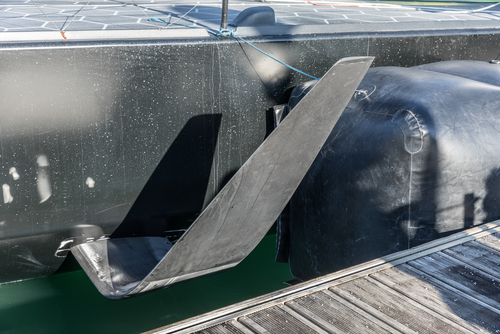
The Origins of the Foil
The concept of the foil dates back to the 19th century. As early as 1861 in Great Britain, Thomas Moy fitted three horizontal foils beneath a small boat. Towed by a horse along the Surrey Canal, the craft lifted above the water’s surface.
In 1885, in France, De Lambert developed a “catamaran-like” structure using paired barrels. Also horse-towed, the vessel rose approximately 20 cm above the water, lifting the barrels clear of the surface.
A decade later, De Lambert and Phillips constructed one of the first true hydrofoils: a catamaran supported by four transverse hydrofoils with a total surface area of 5.10 m². It was powered by an engine recovered from an aircraft designed by Horatio Phillips, driving a long-shaft propeller at 800 rpm.
In 1897, development continued in the United States with a hydrofoil craft designed by William and Larned Meacham, equipped with forward and aft foils.
At the dawn of the 20th century, De Lambert introduced the first self-propelled hydrofoil (1904), powered by a 14 hp De Dion internal combustion engine. Featuring five U-shaped transverse foils, this 6 m by 3 m vessel—named Hydroplane—reached a speed of 31.975 km/h.
Further innovations followed worldwide: in the United States with the Wright brothers, in France with Alberto Santos-Dumont, and in Canada with Alexander Graham Bell and Baldwin.
Over the following decades, hydrofoil technology advanced significantly, initially attracting designers of motor vessels. Both merchant and naval fleets adopted foils to improve speed and stability. Gradually, the technology extended to smaller craft, as hydrofoils demonstrated their ability to “fly” above the water.
In the 2000s, Ray Hamilton pioneered foil surfing by mounting a foil beneath a board, leading to major performance gains in watersports such as kitesurfing and wakeboarding.
How Does a Foil Work?
In fluid mechanics, a foil (or hydrofoil) is defined as a profiled wing moving through water and generating lift.
Its aerodynamic profile features a convex upper surface (extrados) and a flatter lower surface (intrados). Water flowing over the upper surface travels faster than water beneath, despite covering a longer path.
According to the Bernoulli’s principle, an increase in fluid velocity results in a decrease in pressure. Consequently:
- Higher pressure forms beneath the foil (intrados), generating upward force
- Lower pressure forms above the foil (extrados), creating suction
This pressure differential produces lift, reducing the wetted surface of the hull and therefore drag, while increasing the vessel’s speed.
As lift increases, the hull is progressively raised, reducing resistance—and in some cases, lifting completely clear of the water.
Foils on Motor Vessels
On motor vessels, the principle is straightforward: propulsion generated by the engine and propeller creates sufficient speed for the foil to produce lift exceeding the vessel’s weight.
At this point, the hull no longer relies on buoyancy (Archimedes’ principle). The vessel is effectively supported by its foils and behaves similarly to an aircraft.
As the hull rises out of the water, speed increases further due to reduced drag. Stability is then controlled in a manner comparable to aviation, using control surfaces rather than traditional hydrodynamic balance.
Foils on Sailing Yachts: Displacement Monohulls
Traditional displacement sailing yachts operate according to Archimedes’ principle: they move by displacing water and are limited by a theoretical hull speed related to their waterline length. Their V-shaped hull provides directional stability and seaworthiness, even in heavy conditions.
On such yachts, propulsion is generated by the sails, introducing a key factor: the heeling moment. This lateral force must be carefully managed, as it influences both performance and stability.
In high-performance craft such as the Moth class, stability is achieved through the combined effect of the sailor’s weight distribution and the position of the foil’s centre of lift.
On multihulls, particularly catamarans, foils act as pivot points to counteract heeling forces when the vessel is pressed to leeward.
For displacement monohulls, however, integrating foils is more complex. Increasing sail power enhances speed but also amplifies heeling forces. To counteract this, designers employ canting keels and water ballast systems to shift the centre of gravity windward.
However, these solutions reduce lateral resistance, often requiring additional appendages such as daggerboards. This complicates the integration of foils on displacement monohulls.
As a result, it is generally not possible for such yachts to achieve full lift-off. Nevertheless, foils still improve performance by:
- Enhancing the effectiveness of canting keels, increasing righting moment and speed
- Reducing wetted surface, thereby lowering drag
- Providing lateral lift to reduce leeway (depending on foil design)
While beneficial, these gains are less dramatic than those achieved by fully foiling vessels operating in a true “flight” regime.
Foiling Monohulls in the Vendée Globe
Foiling monohulls were introduced in the Vendée Globe in 2016. However, they do not achieve full flight, as IMOCA class rules prohibit the use of lifting foils on rudders.
Naval architects at CDK Technologies notably developed the IMOCA Charal, featuring an innovative hull design with a pronounced flared bow and a rounded, enclosed stern. These design evolutions aim to maximise foil efficiency, allowing yachts to partially lift and achieve significantly higher speeds.
Foiling Trimarans in the Route du Rhum
In contrast, this limitation does not apply to trimarans competing in the Route du Rhum. These vessels have evolved into true “flying trimarans”.
The Ultime class multihulls represent the cutting edge of performance, capable of reaching speeds exceeding 80 km/h. Their development has sparked ongoing debate between performance optimisation and safety considerations.
The 2018 edition of the Route du Rhum marked a major testing ground for these foiling giants, whose objective is clear: to achieve sustained flight above the water’s surface and push the limits of offshore sailing performance.
Foil technology represents a major breakthrough in naval architecture, fundamentally redefining the relationship between hydrodynamics, speed and efficiency in both sailing and motor vessels.