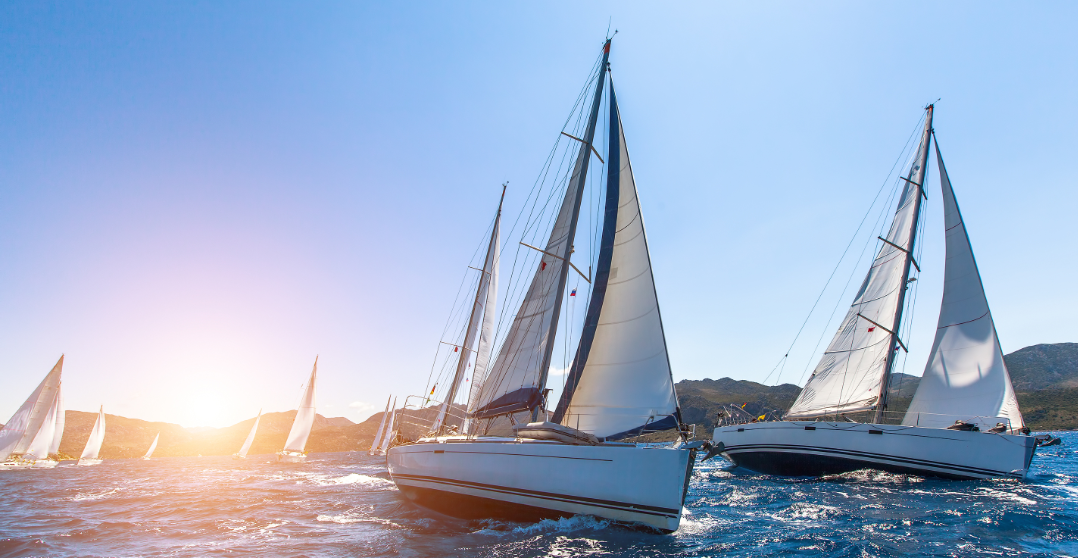
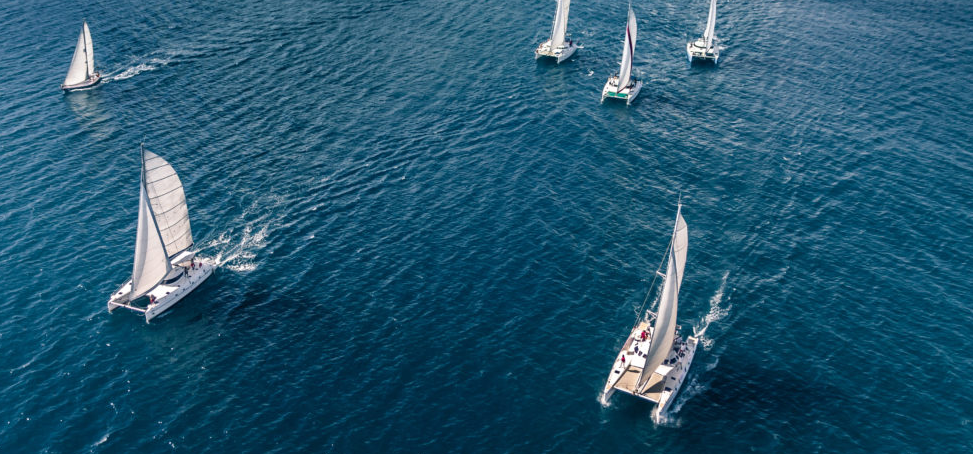
Sailing vessels, historically used for transporting goods, mail and passengers—as well as for naval warfare and fishing—are now primarily dedicated to leisure cruising and competitive sailing.
The development of water-based sports has significantly contributed to the evolution of sailing yachts and their rigging. Innovative materials and new design approaches have enhanced every structural component (hull, keel, masts, sails and spars), greatly improving overall performance.
As a result, sail shapes have evolved, speeds have increased, and manoeuvrability has improved across all types of vessels.
Square Sails
The galleys of the Phoenicians, followed by those of the Greeks and Romans, carried a single square sail. When sailing against the wind, propulsion was supplemented by oars.
The Vikings, whose longships (drakkar) were also equipped with square sails, introduced the use of a bowline, enabling the sail to be trimmed sideways and thus allowing limited upwind sailing.
Over time, square-rigged vessels became increasingly complex, with multiple masts and sails. Some have become iconic, either for their historical achievements or their construction.
The Duchesse Anne, with its steel hull, is a notable example of naval architecture and remains the last preserved three-masted square rigger in France. On such vessels, masts are typically divided into three sections:
- Topgallant mast (upper section)
- Topmast (middle section)
- Lower mast
Each section carries square sails.
During the same period, barques differed by having two masts rigged with square sails and a third mast rigged fore-and-aft (mizzen mast).
Triangular Sails
Lateen Sail
The lateen sail, a triangular sail introduced in the 15th century, is traditionally associated with the Mediterranean.
It is rigged on a long, slender yard (lateen yard), attached forward at the tack. Reefing lines run parallel to the yard, and the sail is not fitted with a boom.
Due to the length and weight of the yard, this sail is generally suited to smaller vessels and makes reefing operations more complex.
The lateen sail was used on early caravels, including the Pinta and the Niña, which accompanied Christopher Columbus in 1492.
Note: the so-called “Arab sail” is similar, but with a truncated upper corner. It is commonly found on feluccas (Nile, Red Sea) and dhows (Red Sea and Indian Ocean).
Bermudan Sail
The Bermudan sail differs from the Marconi sail by having a broader head.
Its luff is free up to the head, requiring the mast—unsupported at the top—to extend above it. The foot is not necessarily attached along the boom.
Austronesian Sail
The Austronesian sail is a triangular sail with its apex pointing downward, providing significant wind exposure at its upper section.
It is used on small craft in regions such as Southeast Asia (Philippines), the South Pacific (New Zealand) and Madagascar.
Gaff Sails
Gaff sails are asymmetrical quadrilateral sails attached to the mast along one of their four sides (luff, foot, leech and head). They fall into three main categories:
Spritsail
A sail without a gaff, supported instead by a sprit (diagonal spar). The lower end is attached to the mast via a line, the tension of which controls the sail’s shape.
This configuration allows for a relatively large sail area on a short mast.
Gaff Sail
Positioned aft of the mast, the gaff sail pivots around it via the jaw fitting (encornat), which connects the gaff (upper spar) to the mast.
The lower edge may be attached to a boom or left loose.
Note: the Houari sail is a specific type of gaff sail, with a nearly vertical gaff, sometimes aligned with the mast (historically used by naval vessels).
Lug Sail
The yard supporting this sail is inclined, with the forward section lower than the aft section. The attachment point is typically located at approximately one-third of the yard’s length.
A Brief Sail Lexicon
Square Sails
- Royal: small sail above the topgallant
- Topgallant sail: high sail on vessels with multiple sails per mast
- Topsail: set above the course sail
- Fore topsail: on the foremast
- Main topsail: on the mainmast
- Spritsail: small sail set beneath the bowsprit
- Spritsail topsail: smaller sail beneath the jib boom
- Course (mainsail/foresail): lowest sail on a mast
Triangular Sails
- Spinnaker: lightweight downwind sail with a pronounced draft
- Jib: intermediate headsail between genoa and storm jib
- Flying jib: elongated sail set furthest forward on the bowsprit
- Genoa: large overlapping headsail with a low foot
- Storm jib: small, flat sail for heavy weather
- Solent: headsail used upwind
- Staysail (trinquette): smaller version of the solent
- Driver (spanker): aft sail contributing to balance and manoeuvrability
- Foresail (mizzen context dependent):
- On square rigs: largest sail on the foremast
- On Bermudan rigs: the only sail on that mast
- Trysail: heavy-weather sail replacing the mainsail
Gaff Sails
- Spanker (brigantine): gaff sail set on the aft mast
- Mizzen sail:
- On square rigs: may be combined with a spanker
- On Bermudan and gaff rigs: the principal sail on the mizzen mast
The diversity of sail types reflects centuries of maritime evolution, shaped by operational needs, environmental conditions and technological innovation. From square sails to modern fore-and-aft rigs, each configuration offers specific advantages in terms of performance, handling and adaptability.
Understanding these different sail types is essential for both sailing enthusiasts and professionals seeking to optimise vessel performance and navigation efficiency.