Origin and terminology
This rig type was developed in the 16th century by Dutch sailors under the name “Schoener”, which later gave rise to the English term schooner. The French term goélette likely derives from goéland (seagull) and appeared around 1740.
Among the various sailing rigs, many seafarers agree that a schooner under full sail is one of the most majestic sights at sea.
The schooner: general characteristics
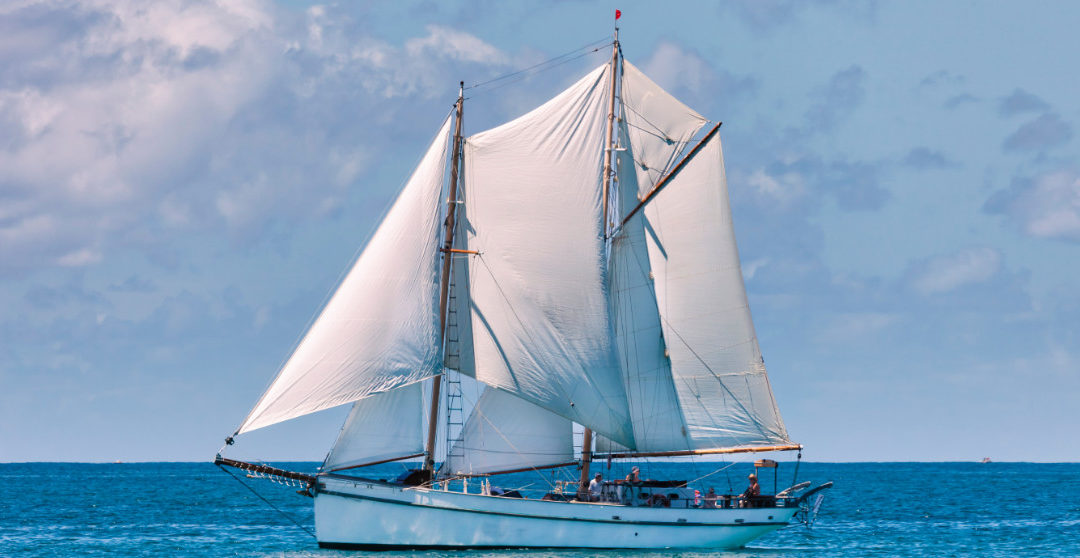
A schooner is a sailing vessel equipped with at least two masts, and in some cases up to seven. The main mast is positioned aft, being the rearmost mast on the vessel.
On a two-masted schooner:
- the foremast is called the foremast,
- the aft mast is the main mast, which is either equal in height or taller than the foremast.
Schooners are characterised by:
- relatively light displacement,
- fine hull lines well suited to windward sailing,
- masts slightly raked aft,
- gaff sails set on spars (except in Bermudan configurations),
- and generally spreaders without tops (except in topsail schooners).
Schooners reached their peak during the second half of the 19th century, particularly in merchant shipping, with increasingly large vessels featuring three or more masts.
The different types of schooners
Fore-and-aft schooner (gaff schooner)
Rigged entirely with gaff sails, without topsails or square sails.
Topsail schooner
A schooner in which the foremast carries one or two square topsails above a gaff sail. These square sails enhance performance when sailing downwind.
Double topsail schooners—where each mast carries a topsail—exist but remain rare.
Bermudan schooner
Rigged with triangular (Marconi) sails and no square sails. Many modern schooners adopt this configuration for ease of handling and improved upwind efficiency.
Three-masted topsail schooner
A hybrid rig combining square sails (typically on the foremast or main mast) with an aft mast rigged fore-and-aft (gaff or Bermudan), sometimes also carrying topsails.
Multi-masted schooners (three to seven masts)
Each mast carries a fore-and-aft sail at its base. Historically, all six-masted vessels ever built were schooners, as was the only seven-masted sailing ship.
St. Lawrence schooner
Adapted by Québec sailors for coastal trading along Canada’s east coast, these schooners featured flat bottoms to facilitate grounding at low tide.
From the 1920s onwards, petrol and later diesel engines replaced sail power. The aft mast disappeared, while the foremast was retained for cargo handling purposes only.
Notable examples of schooners
- La Belle Poule, sister ship of L’Étoile, is a topsail schooner that served during the Second World War with the Free French Naval Forces.
- Thomas W. Lawson remains the largest steel schooner ever built and the only seven-masted sailing vessel in history. Each mast bore a distinct name, including references to the days of the week.
- Pen Duick III, built in 1967 for Éric Tabarly, features a 17.45-metre aluminium hull. That same year, Tabarly dominated nearly all Royal Ocean Racing Club races, earning a formidable reputation among British sailors. In 1989, the yacht—skippered by Jean-François Coste—took part in the first edition of the Vendée Globe.
- Tara, a two-masted schooner built in 1989 (originally named Antarctica and later Seamaster by Sir Peter Blake), was intended as the flagship of a global environmental programme. Following Blake’s death in 2001 on the Amazon River, the vessel was laid up before being relaunched in 2003 as Tara. Since then, it has participated in numerous scientific expeditions aimed at raising awareness of ocean fragility and advancing marine research.
Related example: three-masted barque
- Belem, built in 1896, was re-rigged as a three-masted schooner in 1952. Today, it is one of the largest sailing vessels in France. After various transformations and a period of motorisation, it was rediscovered in Venice and restored by a maritime heritage enthusiast. It now serves, among other roles, as a training vessel for the French Navy and has been listed as a historic monument since 1984.