Definition of a ketch
The term ketch is derived from the English word “catch”, referring to fishing catches. Historically, a ketch was a two-masted fishing vessel or cargo ship, often square-rigged.
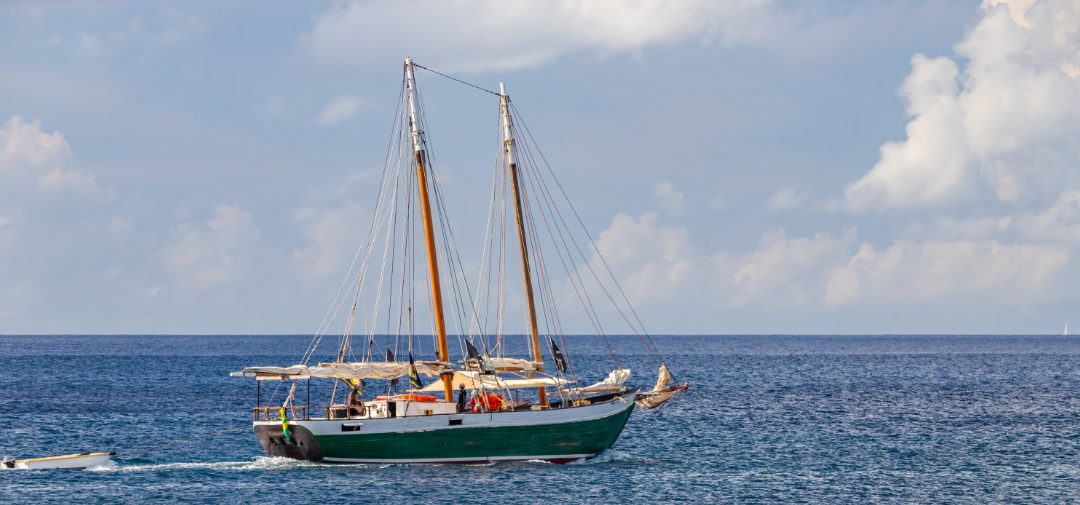
In modern sailing, a ketch is generally defined as a sailing vessel—whether monohull, catamaran or trimaran—equipped with two masts:
- the main mast, located forward and carrying the mainsail, is the taller of the two;
- the mizzen mast, positioned aft, is stepped forward of the rudder stock.
Types of ketch rigs
Several types of ketch can be distinguished according to their rig:
Gaff ketch (double gaff rig)
Both masts carry gaff sails.
Topsail ketch
A variation of the gaff ketch, where the main mast is topped with a square topsail set on a yard.
Gaff-and-Bermudan ketch
The main mast carries a gaff mainsail with a topsail, while the mizzen mast carries a Bermudan (Marconi) sail.
Bermudan (Marconi) ketch
Both the main mast and mizzen mast carry triangular Bermudan sails. The foremast area may carry one or more headsails.
Why choose a ketch?
The ketch is an attractive sailing configuration, offering several key advantages:
- Divided sail plan for ease of handling
The sail area is distributed across two masts, allowing for flexible sail combinations. This is particularly advantageous for short-handed crews, as sail reduction in heavy weather becomes easier and manoeuvres are simplified. - Enhanced balance and versatility
The divided sail plan provides a level of versatility not typically found on sloops or cutters. When the mainsail is lowered, the yacht can continue sailing efficiently under headsail and mizzen alone. This configuration improves balance and contributes to overall stability, particularly in strong winds. - Evolution towards simplified and efficient rigs
Modern ketch design has progressively replaced traditional gaff sails with Bermudan (triangular) sails, which are easier to handle and offer improved upwind performance. As a result, most contemporary ketches are Bermudan-rigged.
A notable limitation
The principal drawback of a ketch lies in reduced performance on certain points of sail. Upwind, the mizzen boom contributes little to sail trim, as it remains almost permanently aligned with the vessel’s centreline, limiting its aerodynamic effectiveness.
Notable examples of ketches
- Pen Duick II, a Bermudan ketch sailed by Éric Tabarly, won the 1964 transatlantic race. Designed by Gilles Costantini, this lightweight 13.6-metre yacht (6.5 tonnes) featured a plywood hull and a divided sail plan enabling single-handed sailing.
- Aquijo, the world’s largest ketch, built by Vitters Shipyard in 2016, measures 85 metres in length and 17 metres in beam. Its two 90-metre masts carry identical sails totalling approximately 1,192 m², and it is designed for luxury global cruising.
- Sunreef 80, produced by Sunreef Yachts, is an exceptional luxury catamaran. Its rig comprises two masts: a main mast supporting a 200 m² mainsail and a forward mast carrying a 150 m² genoa. With approximately 340 m² of living space, it embodies a design philosophy focused on high-end comfort and detail.
- Étoile Polaire, a traditional gaff ketch built in 1916 with a wooden hull and iron structure, has been restored and repurposed by the Skeaf Association. Renamed Skeaf, it now serves as a platform for social and environmental reintegration through maritime activities.