
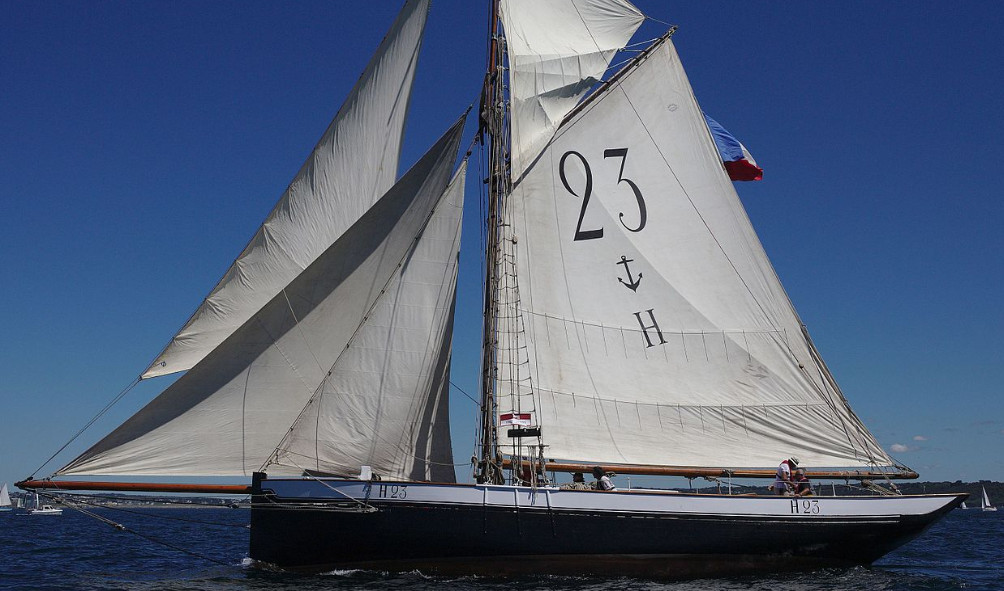
Definition of a Cutter
A cutter is a fast sailing yacht whose manoeuvrability is greatly enhanced by a divided sail plan. Its single mast is typically rigged with a gaff mainsail (gaff cutter), topped by a gaff topsail and supported by a boom at the foot of the mast. Forward of the mast, it carries at least two headsails: a staysail and a jib.
The staysail is an additional sail set on its own stay, positioned between the mast and the jib. It is always the sail closest to the mast and, in heavy weather, can often be handled from within an enclosed wheelhouse.
The jib is set on the forestay, along which it is hoisted and lowered. It contributes significantly to propulsion and plays a key role in simplifying manoeuvres, particularly tacking into the wind. Triangular in shape, its size lies between that of a storm jib and a larger genoa. Cutter-rigged yachts are particularly well suited to cruising, while also capable of strong racing performance—as illustrated by the Pen Duick of Éric Tabarly.
Variants of the Cutter Rig
The cutter may be classified according to its sail configuration:
- Cutter with topsail: one mainsail, one topsail, one topgallant sail, one jib and one staysail
- Houari cutter (high-peaked gaff cutter): one mainsail with a gaff set at more than 45°, one jib and one staysail
- Conventional (gaff) cutter: one mainsail with a gaff set at less than 45°, one jib and one staysail
- Bermudan (Marconi) cutter: one triangular mainsail, one jib and one staysail
Note: the topsail is the sail set above a gaff mainsail in a gaff rig.
The Modern Cutter: Purpose and Advantages
The modern cutter is generally Bermudan-rigged, featuring a triangular mainsail on a single mast, along with a jib and a staysail, each set on its own stay and secured either to a bowsprit or to deck fittings.
This rig configuration is widely used on medium and large sailing yachts, as it allows the sail area to be divided into smaller, more manageable units. This significantly facilitates handling and enhances safety, particularly in adverse weather conditions.
One of the key advantages of the cutter rig is its adaptability in heavy weather. The headsails can be reduced progressively: the genoa or jib can be furled, while the staysail or storm jib—set on an independent stay with a furling system—can be deployed.
In strong winds and rough seas, it is common practice to reef the mainsail (two or three reefs), furl the jib and set the staysail, thereby transitioning from a full sail configuration to a heavy-weather setup.
Notable Cutter-Rigged Vessels
- Pen Duick, the iconic yacht of Éric Tabarly, was the vessel that inspired him from the age of seven and on which he tragically disappeared in 1998. Restored and relaunched in 1959, Pen Duick was a classic gaff cutter equipped with a staysail, a jib and an additional jib (staysail variant).
- Le Renard, a cutter of approximately 70 tons, was once commanded by Robert Surcouf, a legendary corsair. It was armed with four guns and ten carronades and crewed by 46 men of various nationalities, including French, American, Swedish and Portuguese sailors.
- L’Oiseau de Feu, originally named Firebird X, was built by Camper & Nicholson in 1937. Renamed in 1973 and listed as a historic monument in 1992, this cutter was later re-rigged in 1989 by naval architect Guy Ribadeau-Dumas, adopting a more slender sail plan with approximately 250 m² upwind and 550 m² downwind.
The cutter rig remains a benchmark in sailing architecture, offering a refined balance between performance, versatility and safety—particularly suited to offshore cruising and demanding sea conditions.