A jib is the generic term for a triangular headsail fitted at the bow of a sailing yacht. When a yacht is equipped with multiple headsails, these allow the sail area to be adjusted according to wind strength. In such configurations, the jib typically sits between a genoa (larger sail) and a storm jib in terms of size.
The jib is systematically the forward-most sail on the vessel.
Description and associated terminology
As a triangular sail, the jib has three corners:
- Head: the upper corner of the sail when hoisted, where the halyard is attached
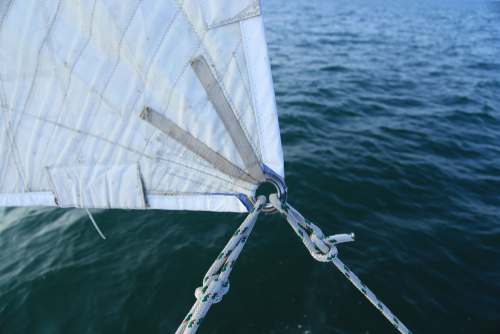
- Tack: the forward lower corner, secured to a fixed point at the bow (typically via a shackle)
- Clew: the aft lower corner, where the sheets are attached
On modern yachts, the sheets are led back to the cockpit on either side of the mast. One sheet is used when the sail is set to starboard, the other when set to port.
The three edges of a jib
- Foot: the lower edge, running roughly parallel to the deck
- Luff: the leading edge, attached to the forestay
- On a genoa, the luff may be secured using hanks or a bolt rope fitted into a furling system or foil
- Leech: the trailing edge, always free, with tension adjusted via a leech line
Each corner of the sail is reinforced with multiple layers of fabric. The headboard (upper section) may be reinforced with metal elements such as aluminium or steel.
Each corner is fitted with an eyelet to connect the sail to the rigging.
The jib is constructed from panels (or sailcloth strips), cut and assembled to distribute loads and create the sail’s aerodynamic shape. Tell-tales are positioned on both sides of the sail to indicate airflow, enabling precise trimming.
Note: a storm jib is typically flat, with little or no draft.
Different Types of Jibs
The term “jib” encompasses several specific types of headsails, each with distinct characteristics:
Furling genoa
The most common headsail on modern yachts. When properly designed, it is versatile and efficient. Thanks to its furling system, it can replace a wide range of headsails (solent, working jib, etc.).
Note: not all sail materials are suitable for furling systems, particularly certain composite fabrics.
Solent (non-overlapping jib)
A non-overlapping headsail, primarily effective upwind in strong winds. It features a nearly vertical leech and a narrow foot.
Its configuration allows trimming via a self-tacking system, enabling the yacht to tack without adjusting sheets. Some solent jibs can be reefed.
Staysail (trinquette)
Set in addition to a furling genoa, the staysail is particularly useful upwind in strong conditions. It is generally not fitted with a furling system, although it may include reefing options.
Yankee
A high-clewed headsail with a relatively large surface area, often used offshore.
Genoa
The most commonly used headsail on modern yachts. It is characterised by a large overlapping area, with a foot extending beyond the mast, partially overlapping the mainsail.
The genoa is a large sail attached along the forestay, with free leech and foot. It is controlled by two sheets attached to the clew.
It is hoisted using a halyard—either to the masthead or, on fractional rigs, at approximately 5/6 or 7/8 height, often in combination with running backstays.
On most modern yachts, the genoa is mounted on a furling system. As wind strength increases, it can be partially rolled to reduce sail area. When fully deployed, it may exceed 65 m².
Storm jib
A small, heavily reinforced sail used in severe weather conditions. Unlike other jibs, it is flat and designed for maximum stability rather than performance.
The jib as a source of additional drive
On modern sailing yachts—whether cruising or racing—the airflow between the mainsail and the jib is a key area of focus for sail trimmers.
Advanced trimming techniques, including the use of barber haulers in addition to sheets, allow optimisation of airflow within this “slot” between the sails.
Two main aerodynamic interpretations exist:
- The Venturi (or slot) effect, where the interaction between jib and mainsail increases overall drive (supported by aerodynamicist Manfred Curry)
- The theory that the mainsail accelerates airflow over the jib, increasing lift and overall propulsion (supported by yachtsman Bertrand Chéret)
A special case: heaving-To
When a yacht is hove-to, forward motion is significantly reduced. This results from the opposing effects of the sails:
- The jib, backed against the wind, tends to push the bow away
- The mainsail produces limited forward drive
As the yacht attempts to move forward, it tends to head into the wind, while the backed jib counteracts this motion—effectively stabilising the vessel with minimal forward progress.
The jib is a fundamental component of a sailing yacht’s rig, playing a central role in both performance and sail balance. Its various forms—ranging from genoa to storm jib—allow sailors to adapt to changing wind conditions while maintaining optimal control and efficiency.
Understanding its structure, function and aerodynamic interaction with the mainsail is essential for both cruising sailors and racing crews seeking maximum performance.