
Spar afloat: definition
At sea, maritime buoyage systems—ensuring the safety of vessels and navigation—are governed by the International Association of Marine Aids to Navigation and Lighthouse Authorities (IALA). A spar in this context refers to a rigid, fixed mark such as a beacon tower or a post. By contrast, a buoy is a floating mark secured to a mooring block on the seabed.
Since 1980, IALA has divided buoyage systems into two regions:
- Region A: Metropolitan France, New Caledonia, French Polynesia and Réunion;
- Region B: French Guiana and the Caribbean, as well as the wider American continent, Korea and Japan.
The sole distinction between these two regions lies in the colour of lateral marks:
- In Region A, green marks indicate starboard and red marks indicate port;
- In Region B, this convention is reversed.
It should be noted that lateral marks define navigable channels (rivers, harbour approaches, etc.), whereas cardinal marks indicate the direction of safe water relative to the four cardinal points.
Spar on board a sailing yacht: definition
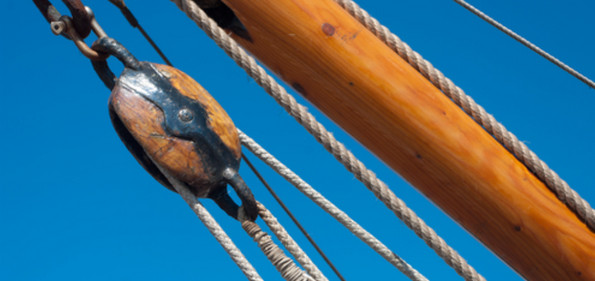
A spar is a rigid, elongated structural element forming part of a sailing yacht’s rig. Traditionally made of wood, spars on modern yachts are also manufactured from metal alloys or composite materials such as carbon fibre.
On board, spars include masts, booms, bowsprits, yards, sprits, bumpkins, as well as poles, oars and the tiller—the latter being mobile components.
Most spars are essential to the vessel’s proper operation. They enhance performance and enable both sails and yacht to operate at optimum efficiency. Their respective functions are outlined below.
Principal spars and sail configurations
The mast may be constructed from aluminium, steel, wood or composite materials. It can be built as a single section or assembled from عدة sections. Masts support yards, which in turn carry sails:
- Square sails are set on yards positioned perpendicular to the mast;
- Triangular sails are hoisted on the mast via the halyard and secured at their foot to the boom; a topsail may be set above;
- Lug sails are trapezoidal and bent to a yard whose halyard is attached forward of its midpoint;
- Gaff sails are supported by a spar (the gaff) pivoting on the mast, with a boom along the foot;
- Spritsails are set using a diagonal spar (the sprit), extending from the tack to the peak, with sail tension controlled by the sheet rather than a boom.
On multi-masted vessels, masts are aligned longitudinally along the vessel’s centreline. The mast constitutes a fundamental structural element supporting the sail plan and enabling wind propulsion.
Types of mast
The mast typically steps on the keel, passing through the deck via the partners. When deck-stepped, it must be supported by a compression post.
The main mast
Once installed, the main mast requires precise tuning. Lateral alignment, longitudinal rake (forestay tension) and, where applicable, mast bend are set in harbour and validated at sea. Mast tuning directly affects helm balance: reducing rake in harbour combined with reefing under way decreases weather helm, and vice versa.
The bowsprit
Located at the bow, projecting forward above the stem, the bowsprit is a major spar and a key structural element of the rig. It facilitates sail handling in strong winds by projecting the tack of downwind sails forward. When flying a gennaker, the bowsprit prevents it from interfering with the leading edge of the genoa, thereby preserving aerodynamic efficiency.
Note: the bowsprit is not counted among the vessel’s masts.
The foremast
Situated forward on multi-masted vessels, the foremast carries either a single fore sail on Bermuda rigs or multiple square sails on traditional square rigs.
The mizzen mast
Located aft, the mizzen mast supports the mizzen sail, typically the lowest and largest sail set on that mast.
Note: on a yawl, where the mizzen mast is particularly small, it is referred to as a jigger mast.
While masts are the most visible spars, other, more discreet elements are equally essential.
Other spars on board
Note: the generic term dromme refers to all spare or unused spars carried on board.
The bumpkin
Usually articulated and retractable, the bumpkin is a spar not used under sail but designed to secure the mizzen sheet on a yawl or the clew of a gennaker aft of the hull. It is also considered a form of bowsprit.
The sprit (balestron)
A generic term for any spar used to set or extend a sail. It may also refer to the spar controlling a topsail or similar extension. In certain configurations, it pivots horizontally, allowing sail orientation to be adjusted via the spar rather than by trimming the sail alone.
The spinnaker pole
When used with a spinnaker, this spar is held horizontally by a topping lift and downhaul, and connected to the sail via the guy, acting as a counterpart to the boom when sailing downwind.
The cleat
A fitting with horns or ears around which lines (halyards, sheets, etc.) are secured.
The staff
A lightweight spar, such as a jib stick, flagstaff or topsail yard extension.